I get up early. Really early sometimes. I have bundles of energy for the day – and then, whoosh, it’s midnight. How does that happen? Along the way, I am bombarded with information. I once read that a study showed we receive 10,000 attempts a day to get our attention – from advertisements, emails, tweets, whatever it might be. 10,000. At least. In the mix are the endless cyberspace twitterings and mumblings. Of which this blog is of course one! How do you decide whom to read, whom to pay attention to? I stopped my twitter account as it was frankly an invitation to read drivel – and not only my own…. Do people actually talk to one another any more? Are we all so vain that we want our views to be heard and read by the entire world? Why, indeed, am I writing this blog? Well, meat for a discussion another day maybe but the point I wanted to get to is that I have found one (arts) blog which is tremendous and absolutely worthy of your time and sign-up. It comes from New York-based
Judith Dobrzynski. Here are a couple of examples. Her tag is
REAL CLEAR ARTS.
by Judith H. Dobrzynski
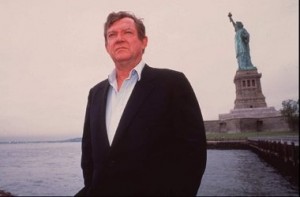
I met the critic Robert Hughes only once, and had no intention of writing about his death until I read a couple of his obituaries, which mostly ignored or belittled one of the things I admired about him. The New York Times didn't mention it, neither did Time magazine's main piece (there's apparently a separate story behind the paywall), and the Wall Street Journal, referring to a review of a book Hughes wrote, faulted him for it.
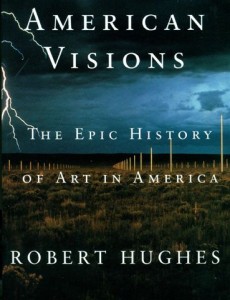
It was not his writing - everyone recognized his high style - or his eye, which agree with or not, signaled a distinct and definite taste, backed by erudition. No, I liked Hughes because he believed that American Art was/is underrated and did something about that - making an eight-part public television series called "American Visions" in 1998. That's when I interviewed him.
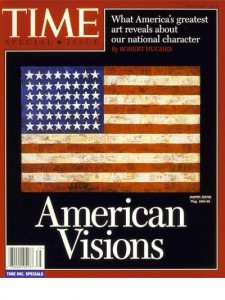
My piece, A Critic Distills American Art into Eight Hours, describes the grueling work that went into the series, which was produced with comparatively little money given its ambitions; the accompanying 648-page book; and a special issue of Time magazine, where he was then critic (here's an index to his work there). (Can you imagine Time putting out a special issue on art today?) Here's an excerpt from my article:
...they filmed at more than 100 locations from Maine to Malibu -- without the Hollywood conveniences.
"Whenever I'd see movie crews in SoHo, with their mobile toilets and makeup vans, I'd get jealous," Mr. Hughes recounted. "Our makeup van was carried by a production assistant in her handbag. And when I was dripping in sweat, someone would produce a ratty package of Kleenex."
The sheer volume of work was a bigger strain, threatening Mr. Hughes's marriage and sending him to a psychiatrist for the first time. "After finishing the series about a year ago, I had severe depression," he said. He blamed overwork, a crisis of confidence and postpartum blues.
Yet with deadlines for the book and then the bonus magazine looming, plus the reviews he writes for Time, there was no time to wallow. Sticking to a schedule he used on the road while writing the scripts, Mr. Hughes got up daily at 4 or 5 A.M. to churn out as many as 3,000 words a day.
"I nearly went bats having to write the book at such speed," he said, dressed in blue jeans and a button-down blue shirt in his loft, which is chockablock with books and papers but devoid of art...
I can attest -- 3,000 words a day is a lot; 3,000 good words is really a lot. But Hughes wanted the accolades his writing provoked:
Mr. Hughes has been noted for his idiosyncratic, nothing-is-sacred willingness to take on both the academically and politically correct, as well as for his vivid, irreverent language: when he says something clever, he will often stop to savor it and to make sure it has been recognized.
Over the years, it has been. Many deem him the most successful art critic today. In profiles and reviews of his books, writers have called him -- besides the apt "ever voluble" -- "erudite," "famously pugnacious," "brilliantly destructive," "consistently entertaining," "sardonic," "pontificating" and a string of other colorful adjectives.
He is certainly "Nothing if Not Critical," the title of his last book about art, a collection of his essays. In them, for example, he disparages the importance of Andy Warhol (on whom he has since mellowed) and taken many contemporary artists down a peg, including David Salle, Eric Fischl and Louise Bourgeois.
Hughes told me then that he wanted to make what became "American Visions" as soon as he finished his more renowned "The Shock of the New" television series -- which was broadcast in 1981. It took him until 1992 to enlist a backer -- the BBC, not PBS, which added to the BBC funding, did Time, later.
Hughes told me much more in the course of our interview, worth reading if you appreciate Hughes -- which artists he regrets leaving out, how he filmed at Monticello, why producers changed locations between 2 p.m. and 4 p.m., why he tied his choices to the land, and so on.
It's worth reading, actually, even if you don't like Hughes, and many people don't. Even his detractors, however, agree that he made people go look at art, which is a good thing.
Chasing Audiences: Too Much Emphasis On Youth?
by Judith H. Dobrzynski
It's pretty obvious that museums -- and most other places as well -- chase the young. They see gray hair in their galleries and fear that no one will rpelace them if they don't do something about it NOW.
I've always had some doubt about that -- many people, I believe, don't have the time for art or the inclination for it until they reach a certain age, which -- anecdotally -- seems to be somewhere in the 40s, give or take, after most people's children have developed some independence.
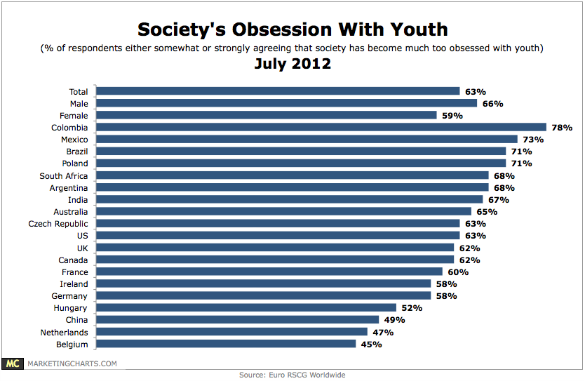
Now comes a survey which agrees that society is too youth-obsessed. According to a firm called Euro RSCG Worldwide, which survey people in 19 countries, "63% of consumers around the world believe that society's obsession with youth has gotten out of hand." Results in the U.S. clocked in at exactly 63%, though the response ranged from 78% in Colombia to 45% in Belgium.
"Interestingly," an article on Marketing Charts said, "this view is shared by 6 in 10 Millennials (aged 18-34)."
7,213 adults took part in the survey, but ages were not stated in the report, nor was the margin of error.
This survey was more about aging itself -- e.g., "55% of the respondents said they look younger than most people their age" -- than it was about choices. But it still makes me wonder. Older people -- and here I mean 40s and above -- seem to resent the attention given to young people, even perhaps at some museums. Museums have to deal with that, making sure that they present a balance of activities and, with luck, a lot of programming that appeals to all ages.
I really love it when I go, say, to the Frick or the Morgan and see people of all ages. And I dislike it when I see costume exhibitions full of young people who never set foot in art exhibitions. Likewise, with diverse audiences for both, say, Jacob Lawrence and, say, Titian.